
Body Control
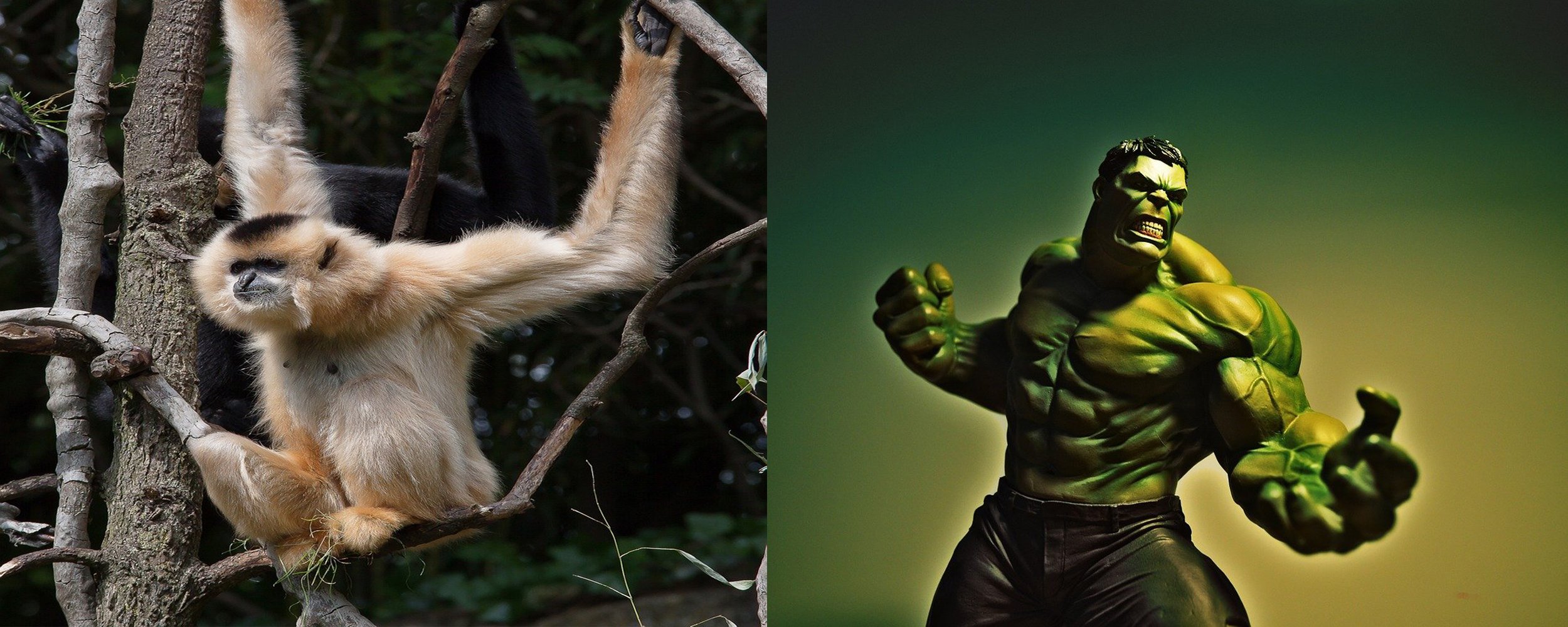
Who has more body control? A monkey or a hulk?
The Feldenkrais Method is a learning method that everyone, whether in good or bad physical condition, can use to improve their body control.
One can use the body control for himself wherever he wants.
The question of talent and physical potential here takes on a new dimension.
According to the Feldenkrais view, having a lot of muscle strength does not mean having good body control.
You can have both. But building muscle initially limits your flexibility. That’s why it’s important to also work on flexibility—perhaps twice as much.
The term “body control” is often understood as something conscious, perhaps exclusively conscious, in the sense of: “I place my leg there; I do it this way.”
There is this aspect—the conscious aspect—in the method used during exercises, and then also in body control out in everyday life, when you’re doing your sport, dance, or whatever else. The tennis coach says, “Keep your arm lower,” and you can do it well without tension in your shoulder, for example. Or you can perform a trick. You execute it. You stay balanced while doing so. The trick is thus considered skillful. But could you perform it even more smoothly?
That would give you even more freedom to do even more tricks, to vary the trick, and so on.
Feldenkrais and performance / self-awareness in sports , Feldenkrais and Acting
What is probably more crucial, therefore, is the unconscious aspect of body control—when what has been learned causes the muscles to interact differently in a way that influences us, makes things easier for us, and happens automatically without us having to do anything or even think about it. We wouldn’t even be able to. The body just moves that way.
The Feldenkrais exercise is done, and the body has realigned itself on its own, having learned how to hold itself up better against gravity. This briefly comes to consciousness when you realize: “Oh, I’ve never done it that way before. It’s so fluid the way I get on my bike.” But it’s hard to explain exactly how.
It just feels right and good. And it looks good, too, if someone were watching. It appears more integrated—that is, more rounded, harmonious, and holistic in its movement.
The body always wants to do everything as effortlessly as possible, to move its weight through space as easily as possible, to drive on the highway in fifth gear—not third, but with the right gear ratio. The large muscles do the heavy lifting, the small ones handle the fine details. Then it looks effortless, beautiful, and never old.
This also applies to the mental realm, to mental organization. How do you put your ideas into action? With a dull, uncreative approach, so that you burn yourself out and the result is mediocre—or you can’t even be happy about it because it cost you too much? Or did you put in just the right amount of effort using the right strategy, and as a result, even come up with better ideas?
(see also: The Psychosomatic Way)
