
Performance (Sports, Music, Mathematics etc.)

Einstein: I am also a performer or I was one :-)
The question in all performance is: What is going on in your brain?
A flexible body means a flexible mind.
There is true flexibilityand those that is ‘just for show’.
Mathematics is also a performance. One of my trainers, Sabine Pfeffer, told me that she actually didn't want to have anything to do with the Feldenkrais Method at first. Her mother, who was a well-known trainer herself, had always tried to convince her. Sabine preferred to study mathematics. She thought she was a bad mathematician. Gradually she let herself be persuaded to try Feldenkrais after all. After a year of training she became a good mathematician.
Feldenkrais makes the brain flexible and thus the body.
In my opinion, a genius never allows external factors to distract them from their discipline. They respect their own pace of learning, regardless of the level of skill expected of them by external standards at any given point in their training. They explore the field in their own way.
Sports
I've had a very positive experience with the Feldenkrais Method in soccer, and I'd like to describe it to show what can happen when you use this method to work on your skills.
My first FI (Functional Integration - Individual Lesson) I had when I was 32. I took three of them, each three to four weeks apart. During that time, I happened to start playing soccer frequently again. I’d always considered myself a technically skilled player. But in front of the goal, I never had the right timing. That changed. I was able to score goals; out of nowhere, I’d gained this “killer instinct.”
The goalkeeper dove to the ground; I moved my foot toward the ball about two meters in front of him, and at the same time was able to adjust my ankle in the other direction. I felt as if I were watching myself from the outside as I flicked the ball past him, as if I had an extra joint in my leg. I just couldn’t believe it. Ever since then, I’ve been firmly convinced that this method can help an athlete reach their full potential.
It’s amazing how much confidence I developed in my body during that time—the confidence that I could draw on a certain technique and, as a result, deliver a great performance with what felt like very little effort. In terms of body control, I was superior to virtually every 20-year-old. My overall technique became increasingly refined. My hip joints became so flexible that, even at 1.82 m tall, I could dribble in the tightest of spaces—and thus always surprise my opponent with movements that came naturally to me but completely threw him off balance because they were physically impossible for him. He couldn’t even imagine them. Otherwise, he could have made the play and stopped me.
The benefits of the Feldenkrais Method range from quickness off the mark and agility to spatial awareness and an overview of the game. The more you are aware of yourself, the more you perceive your surroundings. The more alert your body is, the fewer blind spots there are, the more you have that “180-degree–360-degree overview,” and the better your timing. This improved timing—this better internal timing—allows you, for one thing, to handle the ball more effectively. You no longer have to execute a move technically. It comes more naturally, out of the flow of the game. You can use any part of your body to guide the ball in a specific direction. Your body’s orientation becomes clear. You stay focused and maintain your balance—and thus your spatial orientation—even in tricky situations. You can master tighter game situations or better position yourself within the broader context of the game, or better adapt to the flow of the game—and again, time your actions better—because you perceive the other players more accurately and can better assess them: their timing, their playing behavior, and the direction they’ll run. You become a more fluid player, more adaptable, yet you’re just as capable of turning the game around decisively because you have a better feel for the rhythm and can better anticipate when a change in rhythm is needed.
Since the Feldenkrais Method focuses on movement it could be a lot of fun for athletes to experiment with it and explore their sport on this additional level. It prevents you from falling into a rut, expands your repertoire, and can give you a certain sense of boundlessness. You can grow and become stronger. The possibilities are endless.
The question of talent and physical potential takes on a new dimension here.
Until now, Feldenkrais has been used in sports mainly for rehabilitation or prophylaxis against injuries.
Feldenkrais takes into account the individual structure of a body. A body is not built symmetrically. It performs asymmetrical actions throughout life and therefore becomes increasingly asymmetrical in its muscular organization and also in its skeletal structure.
The Feldenkrais Method is based on the premise that the body is best organized when this asymmetrical organization can be perceived. Then the person can better establish symmetry in response to external demands—such as lifting a box—and then release it again. In this way, the body can make optimal use of its resources and relax optimally.
A more pronounced asymmetry does not have to be a disadvantage. Usain Bolt and Michael Phelps, for example, have both been diagnosed with scoliosis.
And this certainly raises the question of whether they would have been even better without it—or perhaps not nearly as good. Applying this to personality, the question arises as to whether it’s worthwhile to use the method to foster a person’s unique traits and thereby bring out their strengths.
(see also: The Psychosomatic Way)
Example for body control in sports
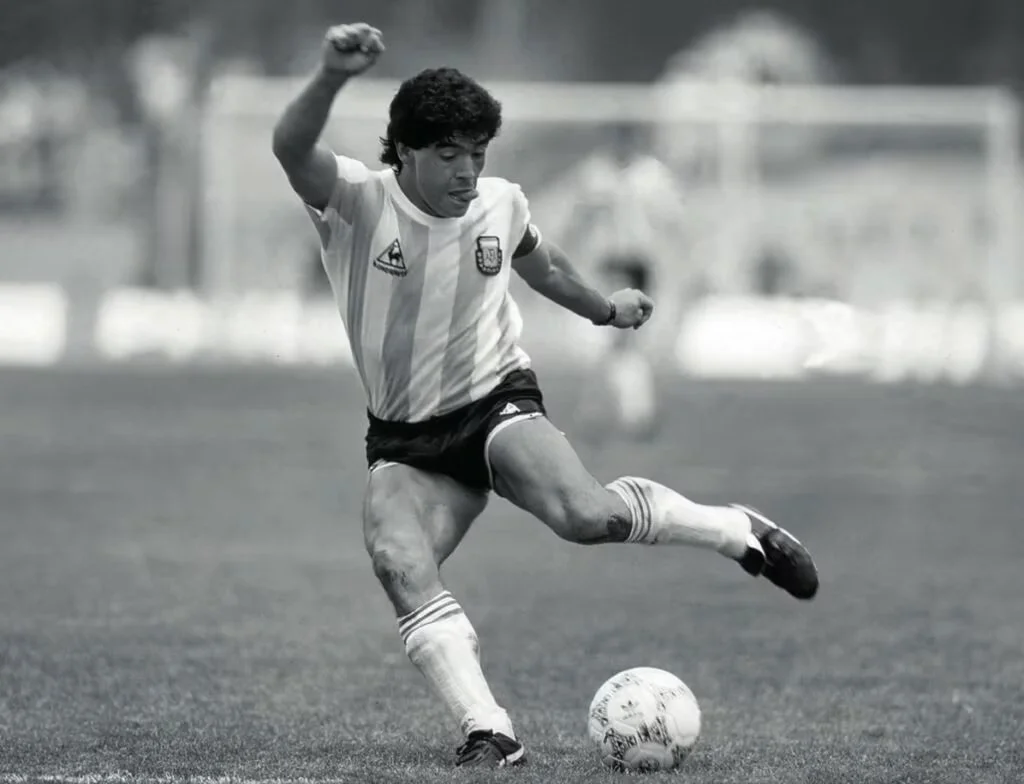
Diego Armando Maradona
